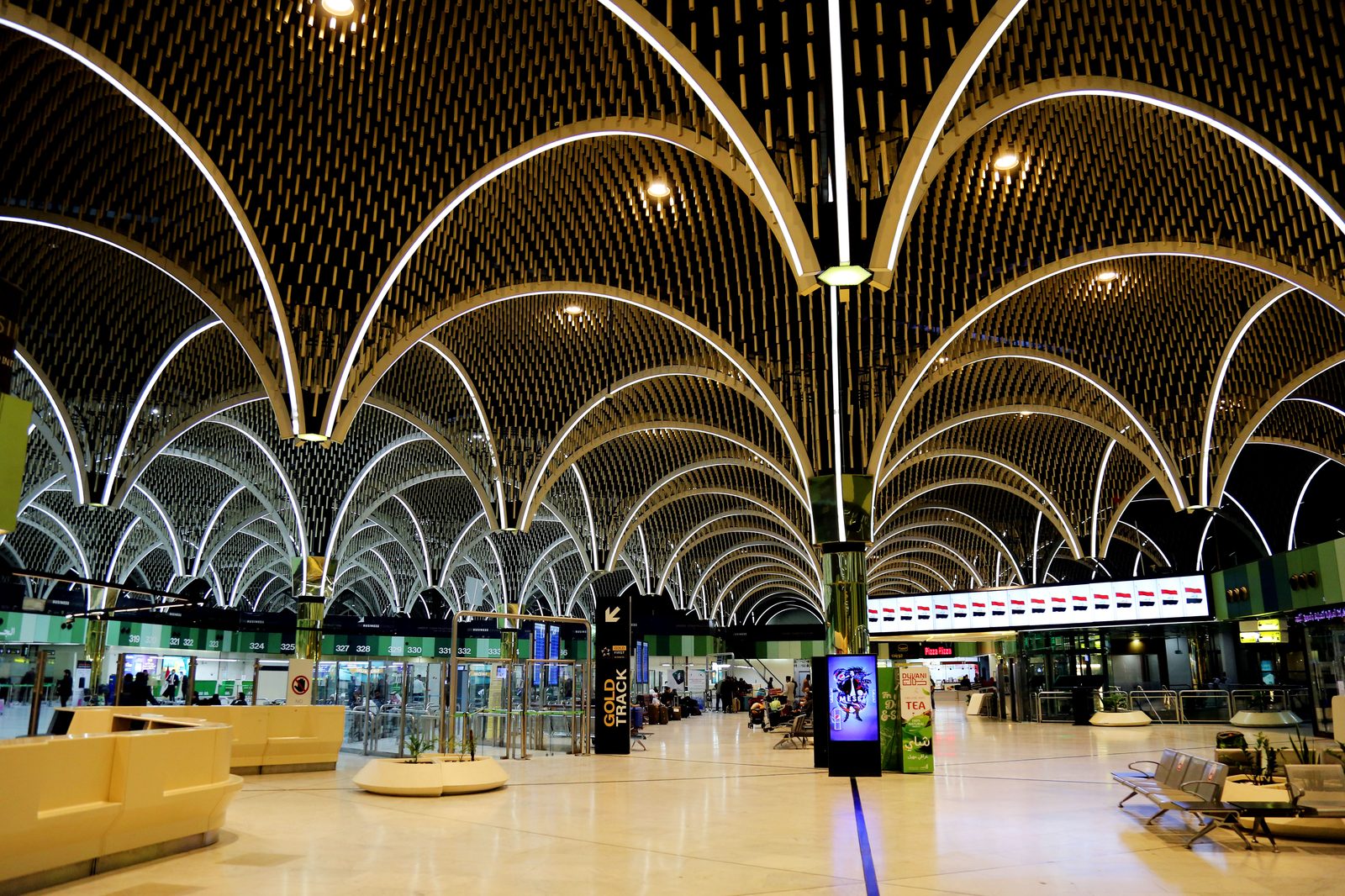
What actually happens between landing and reaching your hotel — the visa sticker, the airport transfer, changing money, and getting a phone working.
How this article was put together. Unlike most of what we publish, this one is not based on reviews written on ZiyarahCheck. It draws on published sources and operator information as at 25 September 2026, and it names no company in return for payment. Conditions in Iraq change quickly — the visa rules, the exchange rate and the mobile networks have all moved this year — so treat everything below as a starting point and confirm the visa position and the rate before you travel. The groups named below appear because they are listed on ZiyarahCheck as taking zaireen to Iraq; naming a group here is not a recommendation.
Checked September 2026. Conditions change — confirm anything that matters before you travel.
Most of what goes wrong on a Ziyarah trip does not happen at the ziyarat. It happens in the first three hours: a queue nobody warned you about, a taxi that costs four times what it should, dollars that get refused, a phone with no signal and a group of forty people waiting.
None of it is difficult once you know the shape of it. Here is the shape of it.
A note on prices. Everything below is given in Iraqi dinars, because that is what you will actually be quoted, and because the dinar has moved a long way this year. Conversions use the Baghdad street rate of roughly 1,580 IQD to the US dollar as at 25 September 2026, with £1 ≈ US$1.34 and €1 ≈ US$1.15. Iraq's official rate is near 1,300, and most travel guides online still convert at that, which makes everything look more expensive than it is. Re-check the rate before you travel.
Before you fly: the visa is not optional any more
Iraq suspended visa on arrival for the country's federal airports on 1 March 2025. Travellers from the UK, Europe, the United States, Canada and Australia now need an approved e-visa before boarding. Airlines check, and they will deny boarding without it.
Apply at evisa.iq — the official portal. There are commercial lookalike sites that charge large markups for the same thing.
The fee is around US$160 (about £120 or €140), which includes mandatory health insurance, and it is payable by card online only. Official processing is quoted at 6 to 72 hours, but through 2026 it has run slower, so apply at least two weeks ahead.
Two practical warnings. Names must match exactly across passport, application and flight booking; mismatched data is the most common rejection. And several European banks block card payments routed to Iraq, so if the payment fails it is your bank rather than the portal.
At the airport: the e-visa is an approval, not the visa
This is the part that surprises people. The approval you print at home is not the visa. A full-page sticker is still printed into your passport on arrival, and that step takes time.
Where it happens varies. At some arrivals there is a separate visa desk where an officer checks documents and prints the sticker, and only then do you join passport control. At others it happens at the immigration booth itself, along with fingerprints and a photograph. Reports differ by airport, by terminal and by how busy the flight is.
Plan for the slower version. Roughly fifteen to twenty minutes per person at that step is the realistic number, which for a coach party of forty means one and a half to three hours from landing to exit. Group leaders should brief families accordingly, particularly those travelling with elderly relatives who will be standing.
Carry printed, not on a phone: the e-visa approval with its barcode, the health insurance policy from the portal, your hotel address, and your return ticket. Two spare passport photos cost nothing and occasionally save an argument.
Who does not go through this
Iranian pilgrims enter visa-free, thirty days, under a bilateral waiver in place since September 2021. It is not an Arbaeen concession and it applies year-round, which is why Iranian zaireen walk straight to passport control while everyone else is queueing for a sticker. In practice most arrive overland rather than by air.
Pakistani pilgrims are in a different position again, and it matters. Pakistan's Ziyarat Management Policy has been in force since July 2025, replacing the older Salar system of private caravan leaders. Religious travel to Iraq, Iran and Syria must now be arranged through a licensed group operator, and that operator carries responsibility for the party's return. Independent pilgrimage travel is effectively closed.
For Pakistani zaireen that makes the choice of operator more consequential than it is for a UK traveller — your visa, your itinerary and your arrival are all bound to the group you book. Checking that group properly is not optional.
Getting out of Baghdad airport
Baghdad International sits inside a closed security perimeter. Ordinary taxis and ride-hailing cars cannot reach the terminal kerb. This catches people out every week.
There are two ways out.
The authorised airport taxi, which waits at arrivals and takes you the whole way into the city. Expect 25,000 to 45,000 IQD — about US$16–28, £12–21, €14–25. It is negotiable, and overcharging of foreign arrivals is widely reported, so agree the fare before the bags go in.
The cheaper route: white minivans leave from the car park opposite the terminal and run to Abbas Ibn Firnas Square, the public roundabout outside the security zone, for 8,000–9,000 IQD (about US$5, £4, €4.50). From there a city taxi into Baghdad is at most 15,000 IQD (US$9.50, £7, €8), and Careem quotes 12,000–13,000 (about US$8, £6, €7). Total, roughly 20,000–23,000 IQD.
The cheap route saves real money and costs you a vehicle change at a roundabout with your luggage. For a family with elderly members, or a 2am arrival, it is not a serious option. Which is the practical reason to ask an operator, before you book, whether the airport transfer is included and what vehicle meets the group.
Careem works in Baghdad, Najaf and Basra but cannot collect at the terminal. Fares within Baghdad run 3,000–7,000 IQD (about US$2–4.50).
Onward to Karbala and Najaf
By shared taxi, per seat: Baghdad to Karbala 10,000 IQD (about US$6, £4.70, €5.50); Karbala to Najaf by minibus around 3,000 (US$2, £1.40, €1.65).
Organised groups almost always travel by chartered coach with the fare inside the package, which is generally the right call for a large party — but it is worth knowing what the independent fare looks like so you can judge whether a transfer supplement is reasonable.
Najaf International Airport is often the better arrival point for Ziyarah: it sits about eight kilometres from the shrine of Imam Ali (as), fifteen to twenty-five minutes away. Airport to central Najaf runs roughly 15,000–25,000 IQD (US$9.50–16, £7–12, €8–14); to Karbala roughly 40,000–75,000 IQD (US$25–47, £19–35, €22–41) over an hour to an hour and a half. There is no public transport from the airport, and fares reportedly rise sharply in peak pilgrimage weeks.
Every fare in this article was researched on 25 September 2026 and comes from published traveller guidance rather than from operators' own price lists. The Najaf figures in particular rest on a single published source. Taxi fares in Iraq are negotiated rather than metered, they move with the dinar, and they rise in the pilgrimage seasons — so treat these as a guide to roughly what is reasonable, not as a quoted price.
Money: what to bring and where to change it
Bring cash, in US dollars, and assume your cards will not work. ATMs exist in Baghdad but often reject foreign cards, and card payment is rare outside a handful of upscale hotels. Treat a working ATM as a bonus rather than a plan.
The notes themselves matter more than people expect. Clean, unmarked, large-denomination bills get the best treatment — new-series $100 notes are what you want. Torn, written-on or old-style notes are commonly refused outright or accepted at a worse rate. It is worth asking your bank specifically for new notes rather than whatever is in the drawer.
Where you change makes a real difference. Licensed exchange offices in the city — the sarraf shops, the gold-souk changers — are generally reported to give the best rate. Banks are slower and worse. Hotels are worse still. Airport counters come off worst. In one published comparison, an airport counter paid 134,000 IQD per US$100 while licensed city changers paid around 150,000 — a gap of ten to fifteen per cent. That is a single reported comparison rather than a survey, but the direction of it matches everything else we found.
So change only what you need at the airport — US$50 to US$100 covers a transfer comfortably — and do the rest in town.
Dollars are widely accepted in tourist-facing places, but a shop or hotel taking dollars applies its own rate, and it will not be in your favour. Changing first and paying in dinars is almost always better.
Declare currency on arrival. Non-residents can only take out what they declared coming in, so the arrival declaration is what protects you on the way home.
Getting connected
A local SIM is usually the practical answer. Iraq has three networks: Zain, Asiacell and Korek. In Opensignal's Iraq mobile network report of January 2026, Asiacell recorded the highest average download speed of the three. Zain is the Baghdad incumbent and runs a product aimed specifically at pilgrims — the Zeyarah Line, valid fifteen days and extendable to thirty, with discounted calling to Iran, Lebanon, Saudi Arabia, Kuwait, Syria, Turkey, Pakistan and the UAE. For a group leader making calls across an itinerary, that is well matched.
A passport is required to register any Iraqi SIM, and the process is slow. SIM counters at Baghdad airport generally run from around 08:00 to 23:00 rather than round the clock, so a late arrival may land with no way to buy one until morning. Whether Najaf airport has SIM counters, and at what hours, we have not been able to establish — if you know, tell us.
An eSIM bought before you fly solves the arrival gap, working the moment you land with no queue and no passport handover. Typical Iraq packages run about US$4.50–5 for 1GB over seven days, US$11–12 for 3GB over thirty days, and around US$17 for 5GB. Two limitations to know: nearly all are data-only with no Iraqi number, which matters when a hotel or a driver needs to call you; and older handsets, common among elderly travellers, often do not support eSIM at all. Check which Iraqi network an eSIM uses before buying, since that is what determines your coverage once you land.
For trips crossing more than one country, global roaming SIMs and multi-country plans are the other option — providers in this category include WorldSIM, Airalo and Nomad. The same check applies: look at which Iraqi network the plan runs on, and whether it covers every country on your itinerary rather than Iraq alone. We have no commercial relationship with any of them, and none of the companies named anywhere in this article has paid to appear in it.
What a group leader should actually do: carry two connections yourself — an eSIM active on landing and a local SIM bought on day one — and do not attempt to register SIMs for forty people at an airport counter. Give three or four deputies connected phones, run a WhatsApp group, and hand everyone a printed card with your Iraqi number and the hotel name and address. WhatsApp calling normally works in Iraq, though it has been blocked during periods of unrest, and it is restricted in Iran for anyone transiting.
One more thing to warn groups about: Iraq runs nationwide internet shutdowns of around ninety minutes in the early morning during national exam days, in May and June. Brief, scheduled, and alarming if nobody told you.
What to ask before you book
Most of the above is fixed — the visa, the rate, the network. What varies between groups is how much of it they handle for you.
Is the airport transfer included, and what vehicle meets the group? Who deals with the visa step on arrival, and does anyone from the group stay with the party through it? Is there help changing money, or is everyone left to find a sarraf alone? For Pakistani zaireen: is the operator registered under the current policy, and who is the representative?
A group that has done this route often will answer all of that without hesitating. One that has not will tell you it will be fine.